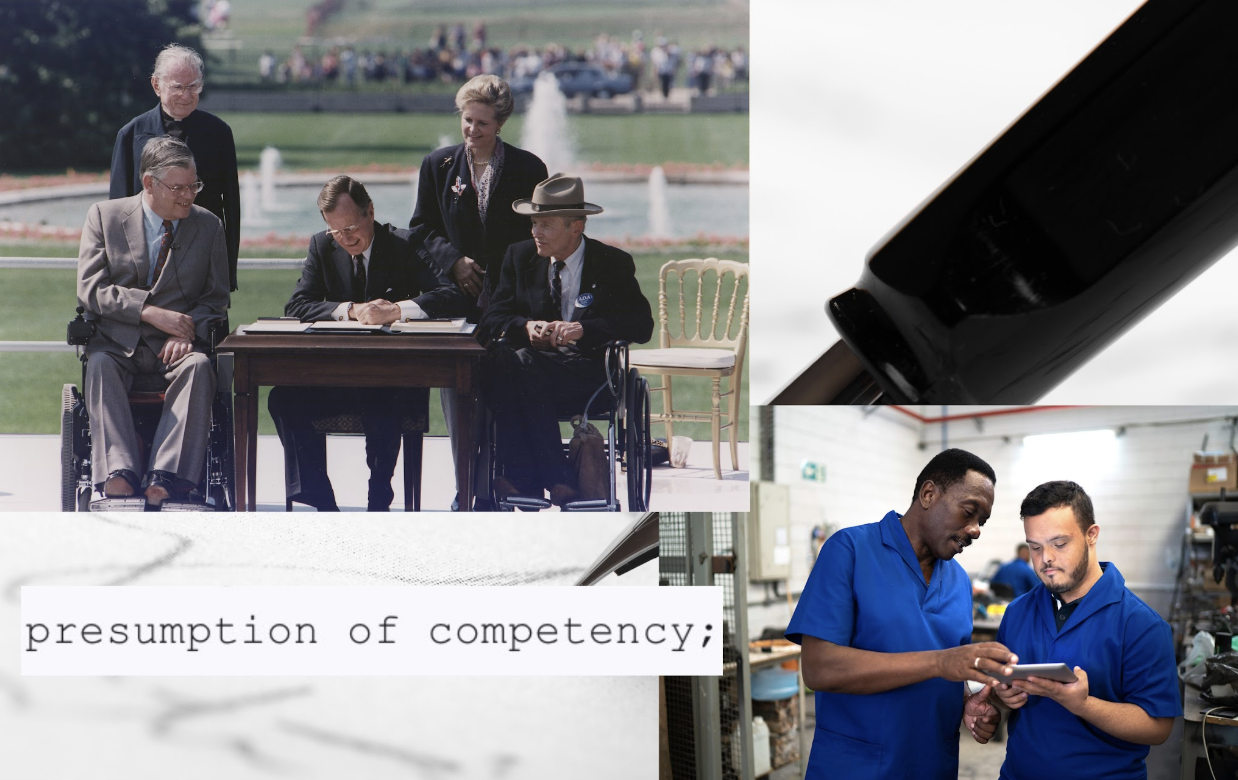
Throughout America, there are curb cuts, Braille, and other disability accommodations all around us. These are enshrined in law by the 1990 ADA. But Texas is the only state to enact a law that promotes independent living, the presumption of competency, and more. It’s all in their 1991 Health & Safety Code. Across the US, the default is for us to assume a person’s cognitive ability based on their surface traits—for example, we hear someone with a speech impediment and assume that they have a lower cognitive or intellectual ability than us, or we assume that a person without a speech impediment functions at our level. Chapter 592 of the Texas Health & Safety code, the Rights of Persons with an Intellectual Disability Act, has community living, autonomy, and human dignity “pre-installed.”
The Texas Default
The sections of Chapter 592 cover things ranging from upholding dignity and self-determination to accessibility and being treated as a competent human being.
Sec. 592.017. TREATMENT AND SERVICES. Each person with an intellectual disability has the right to receive for the person's intellectual disability adequate treatment and habilitative services that:
(1) are suited to the person's individual needs;
(2) maximize the person's capabilities;
(3) enhance the person's ability to cope with the person's environment; and
(4) are administered skillfully, safely, and humanely with full respect for the dignity and personal integrity of the person.
Sec. 592.013. LEAST RESTRICTIVE LIVING ENVIRONMENT. Each person with an intellectual disability has the right to live in the least restrictive setting appropriate to the person's individual needs and abilities and in a variety of living situations, including living:
(1) alone;
(2) in a group home;
(3) with a family; or
(4) in a supervised, protective environment.
Sec. 592.018. DETERMINATION OF AN INTELLECTUAL DISABILITY. A person thought to be a person with an intellectual disability has the right promptly to receive a determination of an intellectual disability using diagnostic techniques that are adapted to that person's cultural background, language, and ethnic origin to determine if the person is in need of intellectual disability services as provided by Subchapter A, Chapter 593.
Sec. 592.021. ADDITIONAL RIGHTS. Each person with an intellectual disability has the right to:
(1) presumption of competency;
(2) due process in guardianship proceedings; and
(3) fair compensation for the person's labor for the economic benefit of another, regardless of any direct or incidental therapeutic value to the person.
Sec. 592.039. GRIEVANCES. A client, or a person acting on behalf of a person with an intellectual disability or a group of persons with an intellectual disability, has the right to submit complaints or grievances regarding the infringement of the rights of a person with an intellectual disability or the delivery of intellectual disability services against a person, group of persons, organization, or business to the Health and Human Services Commission's ombudsman for individuals with an intellectual or developmental disability as provided under Section 523.0360, Government Code.
From Paper to Practice
As awesome as all that sounds, it doesn’t mean anything until it’s enforced—statutory code doesn't enforce itself. A legal right is just dormant code unless there’s an operational system running in the background to detect bugs, monitor compliance, and issue fixes.
In Texas, that runtime engine is Title 26, Chapter 334 of the Texas Administrative Code.
If Chapter 592 of the Health & Safety Code is the high-level policy document, Chapter 334 is the administrative software that actually executes it in day-to-day facilities, state centers, and community programs. It moves human rights from an abstract moral philosophy into a regulated, audited operational workflow. Texas disability rights pioneer Justin Dart Jr. famously said that “Civil rights are not a guarantee of the good life, but an equal opportunity and responsibility to participate in producing the good life for oneself and for all. Government alone cannot implement ADA; this is a responsibility of all Americans.” and “We must undertake a courageous reallocation of our society’s resources from paternalism to independence and productivity.” At the time he said this, society’s view of the disabled focused on pity and paternalism, and he was advocating for radical change for [disabled self-determination, community integration, and full civil rights / how society views and funds disabled independence and productivity / equal access, dignity, and autonomy for all disabled individuals].
Chapter 334 enforces Chapter 592 through three core mechanisms:
- Rights Protection Officers (RPOs): Think of RPOs as dedicated system auditors. Every state facility and community service provider is required to designate independent rights officers whose sole job is to investigate rights violations, review facility policies, and act as a direct channel for individuals to file grievances without fear of retaliation.
- Mandatory System Updates (Staff Training): Chapter 334 mandates that every employee, contractor, and administrator undergoes rigorous initial and recurring training on Chapter 592 protections. It ensures that "presumption of competency" and "least restrictive environment" aren't just obscure legal concepts buried in state records, but daily operating protocol for front-line care teams.
- Administrative Penalties & Overrides: When a provider or facility violates a resident’s statutory rights—whether through unauthorized restrictions on movement, failure to provide adapted communication tools, or ignoring personal autonomy—Chapter 334 triggers immediate administrative reviews, corrective action plans, and potential loss of state licensure or funding.
Without Chapter 334, Chapter 592 would be a collection of well-meaning promises. With it, the law becomes an enforced operating system—setting the stage for what happens when creators take these rules off the legal page and start building physical spaces around them.
Do Laws Actually Change Hearts and Minds?
Does punishing a facility with a fine or requiring administrative audits actually change how human beings view disability? The short answer? Law can force compliance, but it can’t mandate empathy. State regulations can stop a care facility staff member from abusing a resident or violating their rights out of fear of losing their job or license, but they can’t change hearts and minds. As Justin Dart Jr. observed during the fight for civil rights:
“Law creates the environment in which culture can change, but law alone cannot change hearts. That requires people standing up and living the law every single day.”
Punitive enforcement is essential because it sets the bottom threshold—it establishes that violating human dignity carries a heavy cost. But to shift cultural norms, statutory rights must leave the courtroom and enter the built environment.
Code Needs Hardware
Legal code establishes the software rules, but software can't lay concrete or build theme park rides. To see what happens when architects, engineers, and designers take Chapter 592's default settings and build physical hardware to match, we’ll look at San Antonio in our follow-up post on Morgan’s Wonderland.
ABOUT the AUTHOR:
Born with cerebral palsy, Mitch Blatt has been working as The Understanding’s Editor-in-Chief since 2019. He knows how tough it can be to navigate a world that wasn’t built for you. When work is done, he’s an avid gamer and world-builder, currently working on a thriller anthology that uses a logically-consistent constructed world to explore the complexities of life with mental illness.
Transparency Disclaimer: I used an AI assistant for research and drafting. I verified all external sources, incorporated my own voice, and the article was iteratively reviewed and polished by our human team.