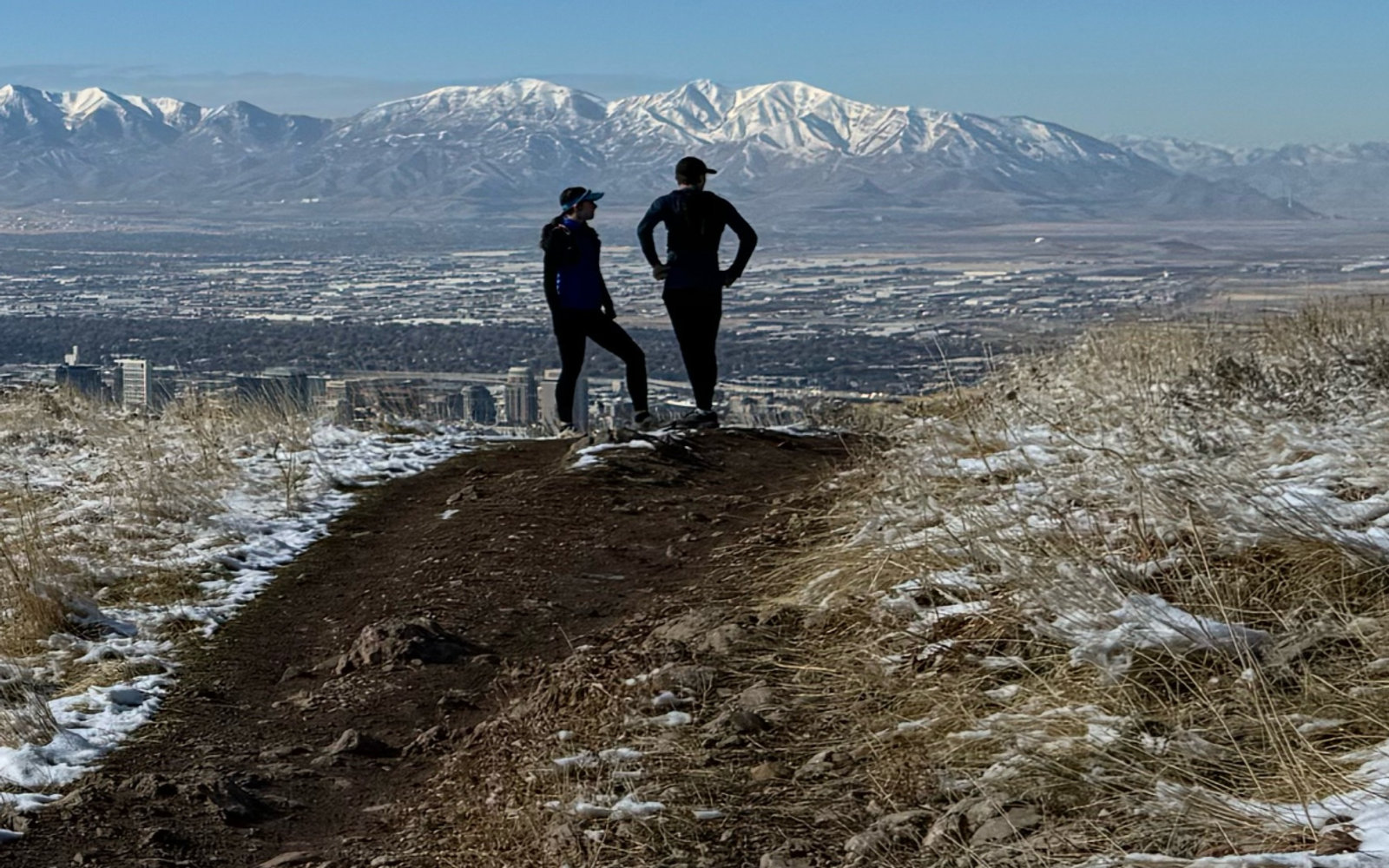
Bliss Louvar and her running partner are at the top of a hill, looking toward some of Salt Lake's gorgeous mountains.
I was five years old in a sterile hospital room with strangers poking me with syringes and placing IVs while my mom and dad were crying. All I knew was that the hospital-grade cup with ice water had never tasted so good. Someone mentioned I had severe hyperglycemia, with blood sugar elevated around 650 mg/dL. I was just learning what numbers meant in kindergarten–how was I supposed to understand “mg/dL”?
I learned to read a syringe before I could read a book
Type 1 Diabetes is an invisible autoimmune disease. No cause, no cure–at least not yet. It’s a challenge without an end in sight, but one that has brought me unexpected capabilities and perspectives I never imagined. From insulin pump changes in school bathroom stalls to the thousands of injections, this disease has become one of the most defining and–excuse my language–most badass aspects of who I am. I learned to read a syringe before I could read a book, and I’ve endured nights of having a timer go off every 30 minutes to monitor my blood sugar–but I also developed the skill to fall back asleep instantly (you’ll appreciate that, 50-year-old self). Some days feel like I’m coming off a battlefield, but I’ve discovered those experiences build resilience for the next fight.
There have been moments in my life when I’ve asked, “Why me?” And then I remember: I was given this challenge because I have the strength to turn it into a superpower. As I grew to understand what it means to be “diagnosed,” I realized that Type 1 Diabetes creates complexity in my life, yet also shapes a unique worldview that enriches my interactions with others. Numerical data like blood sugar readings and insulin doses have become ingrained in my subconscious–not just to monitor myself internally, but to make sense of the world around me.
Some days feel like I’m coming off a battlefield, but I’ve discovered those experiences build resilience for the next fight.
This disease trained me to treat data as instinct, to troubleshoot under pressure, and to adapt quickly. Those skills became the foundation for my academic path. As an undergraduate researcher at the University of Utah, I study algal-bacterial mutualisms and carbon cycling in the Great Salt Lake, designing experiments, performing high-precision carbon isotope analysis, and presenting my findings at university symposiums. The discipline I gained from managing my disability translates naturally to fieldwork, data analysis, and scientific communication.
My disability also shaped how I show up for others. As a Teaching Assistant, College of Science Ambassador, Research Mentor, and Resident Advisor, I mentor students through the challenges of their first STEM courses. Because I know what invisible obstacles feel like, I lead with empathy and honesty–and I strive to make STEM and outdoor recreation more accessible to more people.
Dynamic adaptability is how I’ve learned to keep moving forward while respecting that my situation may mean each step takes a little longer. When I first started running, I couldn’t go more than a mile from my house–not because I didn’t want to, but because I feared my medical condition could put me in an unsafe situation. That fear was frustrating and, at times, made me feel limited before I even began. But I learned to adapt. Flat Coca-Cola, Mike and Ikes, Nasal Glucagon, and a border collie with a bright orange vest to carry my supplies–that’s how I turned one mile into over 26.2.
I went on to complete two marathons and a 14-mile race through the backcountry wilderness of Oregon. Now, I bring that same adaptability into building a life and career rooted in leveraging the obstacles I face and expanding access to the outdoors so that everyone–no matter their background–can experience the freedom the trails bring.
Each day brings a new challenge, but I have always found comfort in the sound of hospital monitors and reality TV shows in medical waiting rooms. I once was frightened by the thought of being alone in the mountains where a hospital was miles away. But over time, the sound of snow falling off the trees as they melt in the sun, or the sound of my feet running over rocky terrain, became my new comfort. So although my skin may be bruised and scarred, those robotic-looking devices attached to my body are, in fact, pretty badass.
So although my skin may be bruised and scarred, those robotic-looking devices attached to my body are, in fact, pretty badass.
Bliss smiling in the lab at Salt Lake University
Written by INCIGHT Scholar Bliss Louvar. Bliss is from Bend, Oregon and is attending the University of Utah, where she is a junior studying Earth and Environmental Science with a Management minor. She is pursuing a career in sustainability management.