

3 Takeaways from Freshman Year
Updated: Apr 22
Note from Mitch Blatt: This article is written from the perspective of an INCIGHT Scholar, a college freshman at the close of his first year—a time marked by questioning, discovery, and rapid personal growth. Read on as William reflects on his experiences with an attentiveness that captures both uncertainty and insight, offering readers an honest look at the early stage of finding direction.

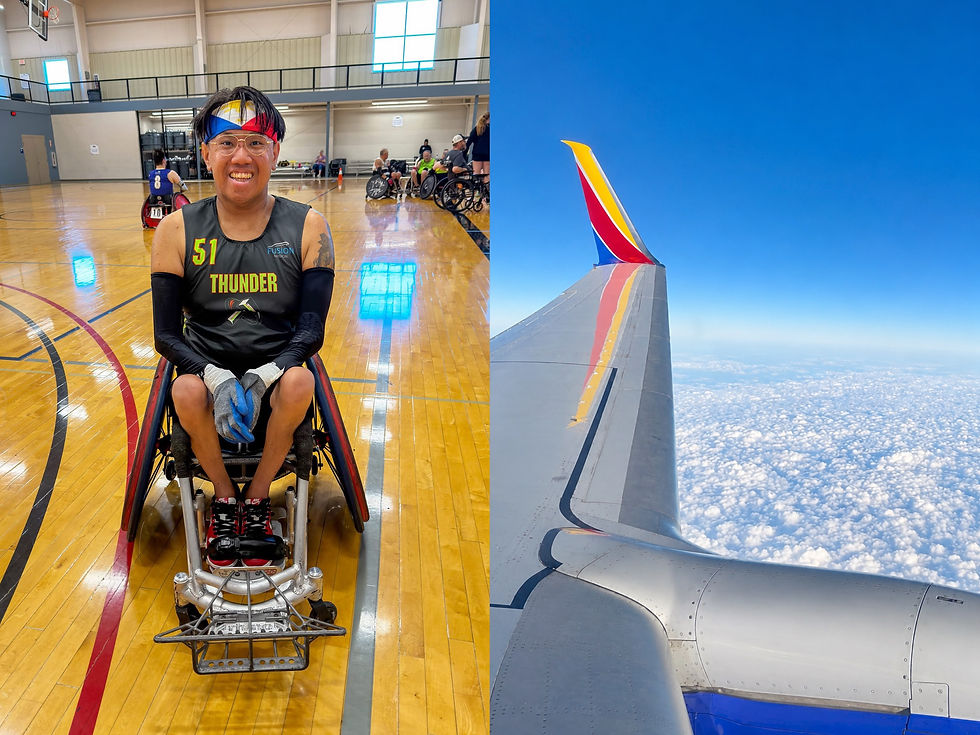
Hello, my name is William. I’m an INCIGHT Scholar, and a current student at the University of Washington, a beautiful place where I've taken great pictures like the one on the left. So far, I have completed two academic quarters. I passed all of my classes, learned many things, and am looking positively toward my future at the University. Despite this, I’ve also identified areas of personal improvement that I’d like to remedy. Today, I'd like to share my experiences and 3 takeaways from two quarters of university, as well as share my goals for next quarter.
It's important to note that I cannot and do not represent all college students with disabilities, and I will inevitably have unique experiences and insights. I should also note that I am high- functioning autistic and ADHD, so on academic matters I tend to do decently well. That's why my 3 takeaways will be more about social and personal aspects of my university experiences, rather than academic aspects.
Procrastination

Similar to many people on the spectrum, I tend to procrastinate on matters. This can be for matters as important as final projects and matters as simple as writing an email to a study partner. This is something I struggled with in high school, which has continued into my university studies. Oftentimes, when I first get an assignment, I’ll immediately plan to do it that day or complete it in portions. But almost always, I'll end up just putting the assignment instructions in my bag and waiting until 3 hours prior to its due date to complete it. What this suggests is that writing down things you need to do, and making a checklist like the one on the right, can be helpful.
Another thing that I want to mention is that avoiding procrastination is a process. As an autistic person, I value consistency and familiarity, and for that reason I need to gradually adapt to changes in my schedule. The more you begin to create checklists and follow those checklists, the easier it becomes. It can also be valuable to focus on what you need to do over the course of a week rather than a day. Let's face it: you aren't going to complete everything you need to do in a day, so don't aim to complete everything in a day. Chop it up into portions for each day, and, over time, build up a habit of completing your checklist.
On this topic, my goal for the last quarter of the year will be to consistently use my calendar, and to find things big or small to do every day that have to do with either school, my personal life, or my job.
Socialization
Going into college, I was surprised and pleased by how many different extracurriculars there were and by how easy it was for me to simply stay home and play video games rather than experiment with any of them. If there’s one thing I’ve learned about socialization, it’s that it requires leaving your comfort zone. For me, an autistic person, that’s difficult, as I tend to avoid places I’m not familiar with or don’t feel comfortable in. But at the end of the day, I’m the only one in my dorm room. I’m the only one reading a newspaper in a restaurant. I need to branch out and find more places to go. And when I find someplace where I can meet people, I need to make an effort to go there consistently. Early in my first quarter, I attended a meeting of a club and had a good time. But after skipping a week, I just didn’t bother going ever again. In order to build familiarity, and become comfortable trying to socialize in a space, we need to experiment with going to new places on a somewhat-consistent basis.
On this topic, my goal will be to find a club or group that meets consistently and is related to an interest I have. From there, I will make it an effort to carve out time every week for said club or group and try to build rapport with the people there.
Self-confidence.
In high school, I didn’t have accommodations and was at the top of my class. This was something I took pride in, which is why it was somewhat of a disappointment to transition to college, which is well known for “not being high school.” On top of that, my refusal to believe I needed help led me to not look for academic accommodations in my first quarter, and not do very well. Sure enough, come second quarter, I requested accommodations and did significantly better. In times like this, it's easy to feel self-doubt. And particularly for people with disabilities, it can feel as if college isn’t a space for us. But we need to remind ourselves that out of thousands of applicants, we were chosen to attend university. It's important to remember that there are resources and accommodations to help us, and taking these resources doesn’t make us any less of a student. And furthermore, we need to remember that we are all deserving of dignity, that we are all unique and important, and that there is a space for us in university.
To finish the year with more self-confidence, I will utilize my accommodations and follow through on my earlier topics of improving my socialization and keeping track of my tasks.
Thank you for reading, I hope this provides a valuable perspective. I would also like to reiterate that all of these topics are ones that can only be improved with time and effort. Personally, I will have to work to maintain consistent growth on these topics, and that is something I will inevitably struggle with, but hopefully achieve this quarter.

ABOUT THE AUTHOR
William is an 18-year-old first-year college student at the University of Washington. His intended major is political science. Born and raised in Seattle WA, he was diagnosed with Autism and ADHD at an early age. His favorite activities include reading, practicing his cello, and watching true-crime documentaries.


Comments